In today’s macroeconomic environment, trade policy uncertainty is no longer a short-term headline risk. It has become a persistent structural factor shaping corporate strategy, cost structures, and investor risk assessment. For risk managers, analysts, and portfolio managers, understanding how companies are internalizing and disclosing these pressures is critical.
Over the past year, shifting tariff regimes, intermittent policy escalations, and the normalization of geopolitical trade tensions have continued to influence corporate language across SEC filings and earnings communications. As these dynamics evolve, Context Analytics’ Unstructured Data Terminal (UDT) remains an essential tool for identifying where risks are emerging, which sectors are most exposed, and how corporate sentiment is changing over time.
Spotlight: The Trade War and Tariffs Surge
Let’s look at a recent example to demonstrate UDT in action.
In early 2025, tariff announcements and subsequent pauses triggered sharp, event-driven spikes in trade-related disclosures. Since then, trade policy has shifted from episodic disruption to an embedded planning assumption for many firms.
Rather than fading, tariff-related language in SEC filings has remained elevated into 2026. The tone has also changed. Companies are no longer framing tariffs solely as potential risks; increasingly, they are describing concrete impacts on input costs, pricing strategies, sourcing decisions, and capital allocation.
This transition, from speculative concern to operational reality, is precisely the type of shift UDT is designed to surface.
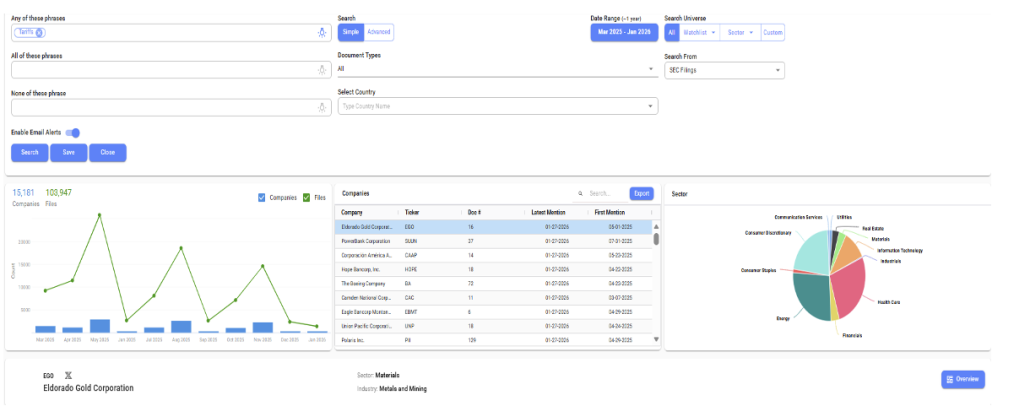
Sector Breakdown: Consumer Discretionary & Healthcare Takes Hit
By leveraging UDT’s sector-level drilldowns, we can identify which sectors and industries are most vocal, and likely most impacted.
Unsurprisingly, Energy stood out, with notable increases in mentions. However, Consumer Discretionary (CD) and Healthcare round out the top 3. We will focus on the impacts of tariffs on the CD and Healthcare sectors.
When investigating the CD sector further, tariffs are impacting Specialty Retail, Textiles, Apparel and Luxury Goods and Household Durables the most. For Healthcare, it is Biotechnology, Pharmaceuticals and Healthcare Equipment and Supplies.
Here are a few standout examples:
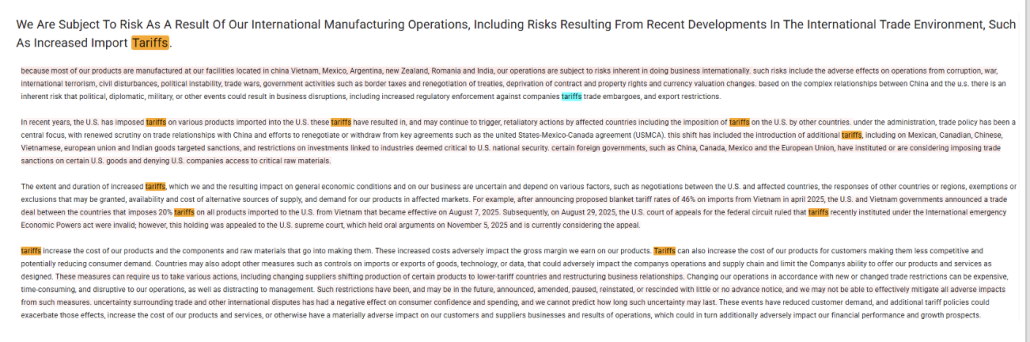
Importantly, tariff-related disclosure is no longer confined to Energy, Consumer and Healthcare. Since 2025, elevated mentions have expanded into Industrials, Materials, and select Consumer and Technology-adjacent sectors, where firms increasingly reference supplier diversification and procurement risk.
Why It Matters for Investors
For investors and risk professionals, the key question in 2026 is no longer whether tariffs matter, but how companies are responding.
UDT enables users to:
This capability supports more informed portfolio construction, risk analysis, and macro-driven strategy development, particularly in environments where policy risk is unevenly distributed across industries.
Final Thoughts
Trade policy uncertainty has become a normalized feature of the global economic landscape. While political debates around tariffs continue, corporate disclosures reveal a clearer story: companies are actively adapting their operations, pricing, and sourcing strategies.
ThemeX cuts through the noise, allowing market participants to see who is talking about tariffs, how frequently, and in what context. As trade dynamics continue to evolve through 2026 and beyond, this lens into corporate risk exposure and sentiment remains indispensable.
Interested in exploring how trade and policy themes are shaping your portfolio? Discover the Unstructured Data Terminal at www.contextanalytics-ai.com.