 company
How social sentiment captured the anticipation across U.S markets
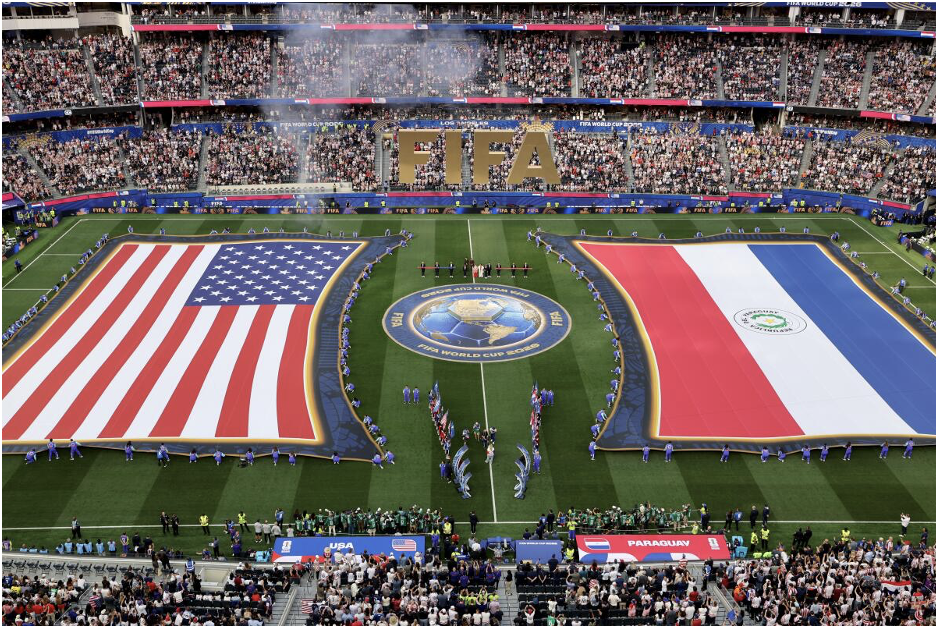
The FIFA World Cup is the single largest recurring sporting event on earth. Held every four years, it commands global viewership in the billions, generates hundreds of billions in economic activity, and for 30 to 40 days reshapes attention, spending, and consumer behavior across dozens of industries. The 2026 edition is the biggest yet: 48 teams, 104 matches, 16 host cities across the United States, Mexico, and Canada.
What does that mean for markets? Existing research has established that World Cup match outcomes move national stock indices in the days following elimination. But the question we set out to answer here is narrower and more practical: can social sentiment data, captured in real time, reflect the World Cup’s effect on the specific sectors and companies closest to the event?
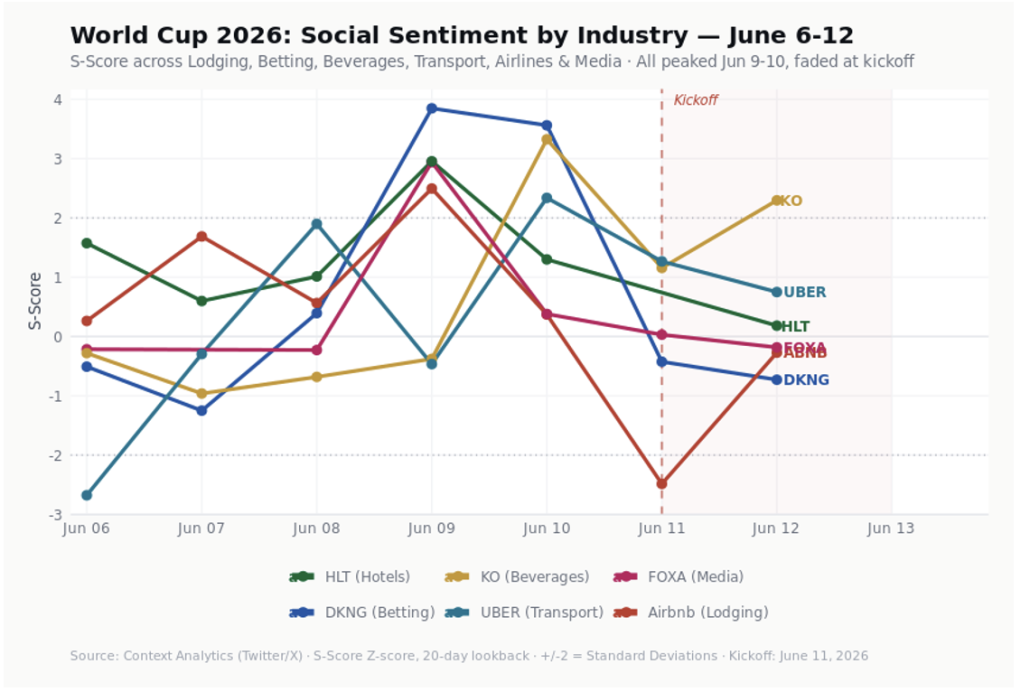
Using Context Analytics S-Score data, a measure of social sentiment derived from Twitter/X, we tracked a cross-section of World Cup-adjacent stocks across four industries in the days leading up to and through the tournament’s opening. The findings point to a consistent pattern across transportation, sports gambling, lodging, media, beverages, and sponsorships: sentiment peaked the day before kickoff and faded once the games began.
BACKGROUND
The World Cup already moves markets. Here’s the evidence.
Academic research going back nearly two decades has documented what analysts call the “mood effect”, which is the idea that a nation’s collective emotional state following a major sports result influences investor behavior. A 2007 study across 39 national markets found that losing a World Cup elimination match produces an average next-day abnormal stock return of −49 basis points in the losing country. Winning produces a smaller, less consistent positive effect.
The mechanism isn’t economic. No match result changes a company’s fundamentals. What changes is the mood of the people making investment decisions. World Cup losses dampen risk appetite; wins create a mild euphoria. At the national index level, this effect is measurable and statistically significant.
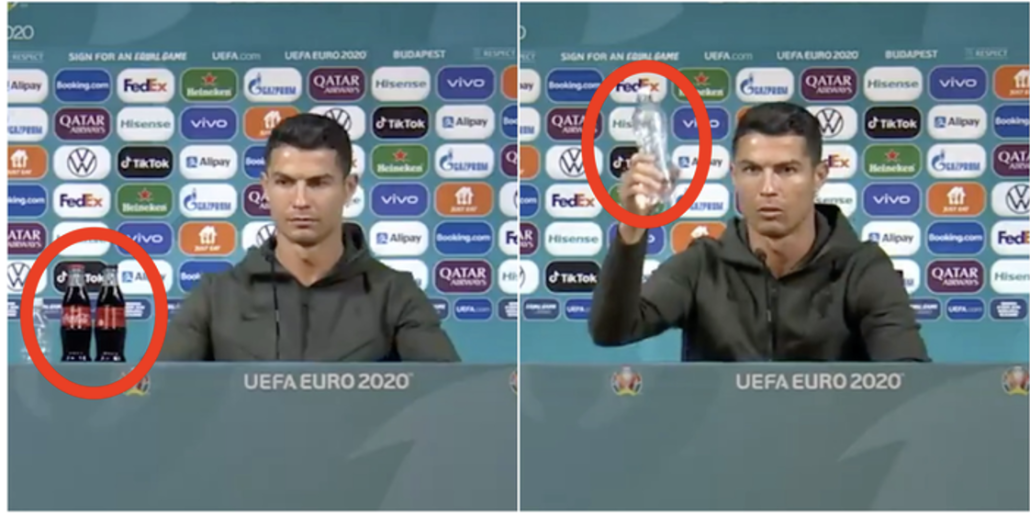
Major football tournaments can also affect individual companies when athlete behavior, sponsorship exposure, and global media attention collide. During Euro 2020, Cristiano Ronaldo removed two Coca-Cola bottles from view at a press conference, held up a bottle of water, and said “Water.” The moment went viral and coincided with a reported 1.6% decline in Coca-Cola’s share price, wiping roughly $4 billion from the company’s market value. While the episode did not prove that Ronaldo alone caused the move, it showed how a single tournament-stage gesture by a global athlete can rapidly become a market narrative for a major consumer brand.
The 2026 World Cup amplifies this dynamic in two ways. First, it will be the largest World Cup ever, meaning more games, more results, more press conferences, more viral moments, and more mood-affecting events across more countries. Second, with the United States as a co-host, the tournament has a direct and unusually strong connection to American markets, businesses, sponsors, media platforms, and consumers.
INDUSTRY ANALYSIS
Four Industries, one event
The World Cup doesn’t affect all businesses equally. We identified four categories of companies with direct exposure to tournament dynamics and tracked their CA S-Score readings across the June 8–12 window: the five days immediately before and after the opening kickoff on June 11.
Transportation
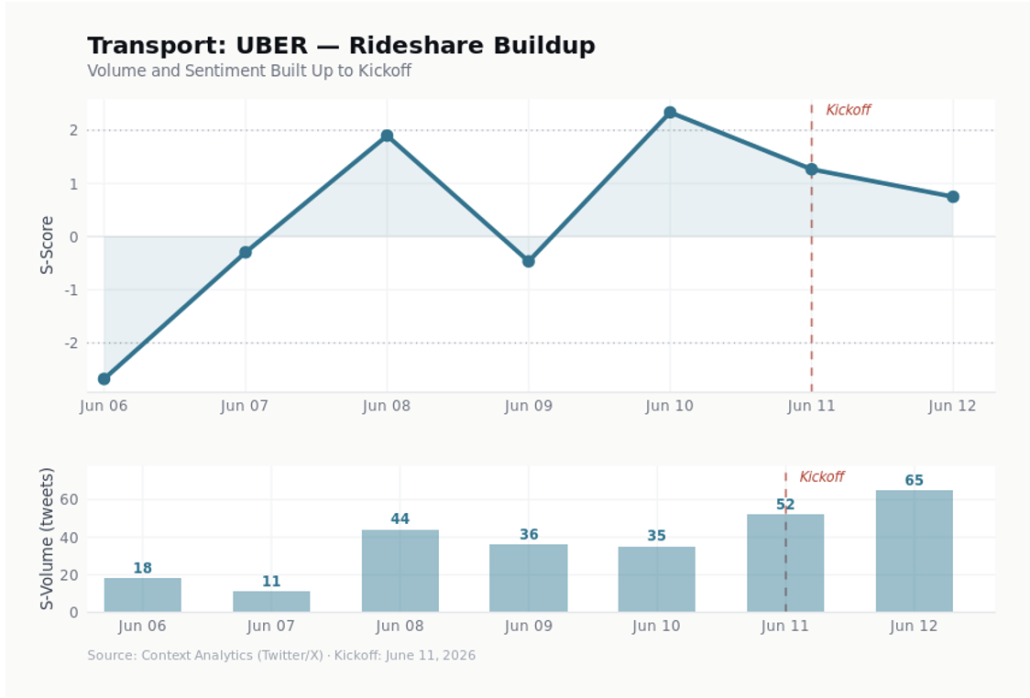
Rideshare and transport companies are direct beneficiaries of the World Cup’s 16-host-city footprint. Deutsche Bank specifically highlighted rideshare as one of the tournament’s top beneficiaries, citing the surge in visitor traffic across host cities. Uber’s S-score supports this view, peaking above 2 one day before the first match kicked off, while message volume rose to its highest level in more than a week. Momentum built quickly in the lead-up to the tournament, with the S-score moving from -2 to 2 in just four days.
Sports Gambling
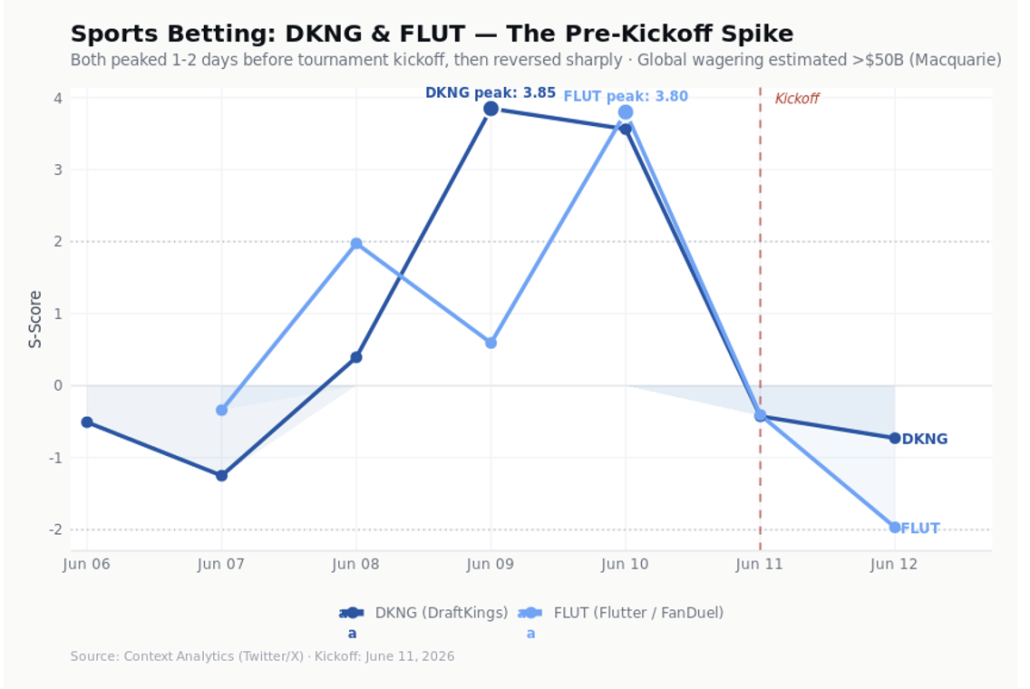
Sports betting also saw a significant pre-tournament spike, with sentiment peaking before the first matches kicked off. DraftKings (DKNG) reached an S-Score of 3.85 on June 9, while Flutter (FLUT), the parent company of FanDuel, climbed to 3.80 on June 10. Both names then reversed sharply once the tournament began. Macquarie estimates that global wagering on the 2026 World Cup will exceed $50 billion, underscoring the scale of betting activity tied to the event. CA data suggests that the market conversation built in the days leading up to kickoff, then faded once the games were underway.
Lodging: Hotels and AirbnbThe lodging sector produced one of the clearest anticipation patterns in the dataset. Across both traditional hotels and alternative accommodations, sentiment peaked at nearly the same time: Airbnb (ABNB), Hilton (HLT), Hyatt (H), and Marriott (MAR) all climbed above an S-Score of 2 on June 9, two days before the first match. That broad-based move suggests investors and analysts were pricing in the same core World Cup travel narrative: higher bookings, stronger pricing, and elevated demand across host cities.The reversal was just as notable. Once the tournament began, all four lodging names rolled over, but Airbnb saw the sharpest negative swing, falling below -2 on opening day. That move stands out because it cut directly against the company’s FIFA-linked growth story. Airbnb is the Official Alternative Accommodation and Experiences Booking Platform for the FIFA Club World Cup 2025, and a supporter of both the FIFA World Cup 26 and FIFA Women’s World Cup 2027; the company has also projected that more than 380,000 guests will use Airbnb during World Cup 26, generating an estimated $3.6 billion in economic impact for host cities.
In other words, lodging sentiment broadly peaked before kickoff, but Airbnb’s post-kickoff reversal was the most dramatic. The data suggests that the broader accommodation trade was well anticipated heading into the event, while Airbnb may have faced a sharper Day 1 sentiment reset tied to concerns around pricing, availability, or host-city execution.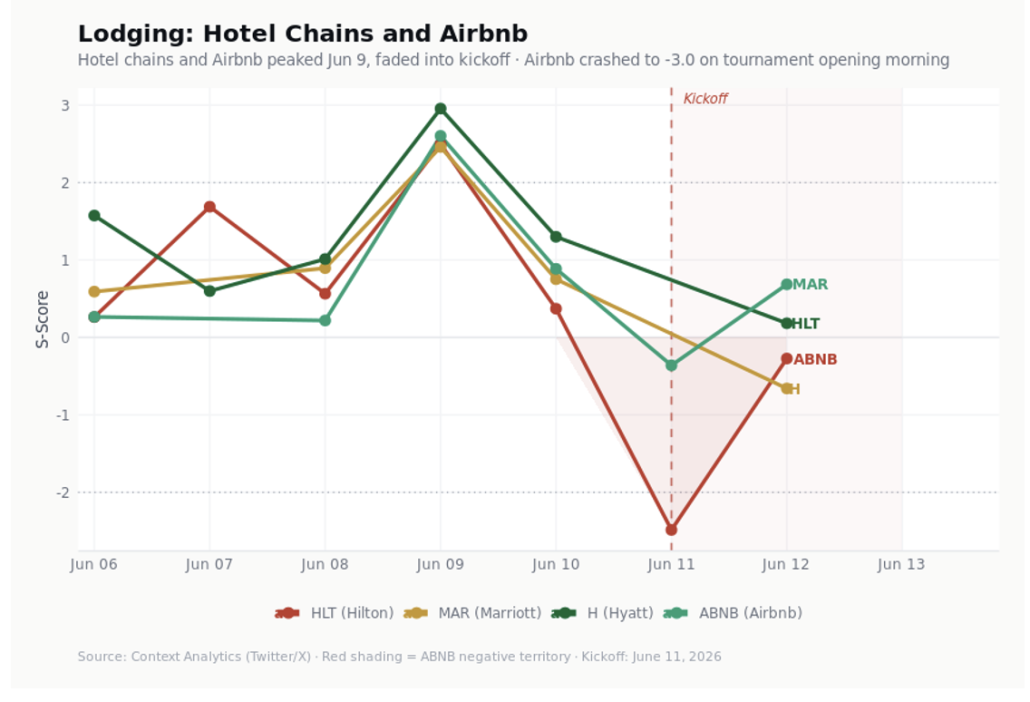
Sponsorships & Beverages
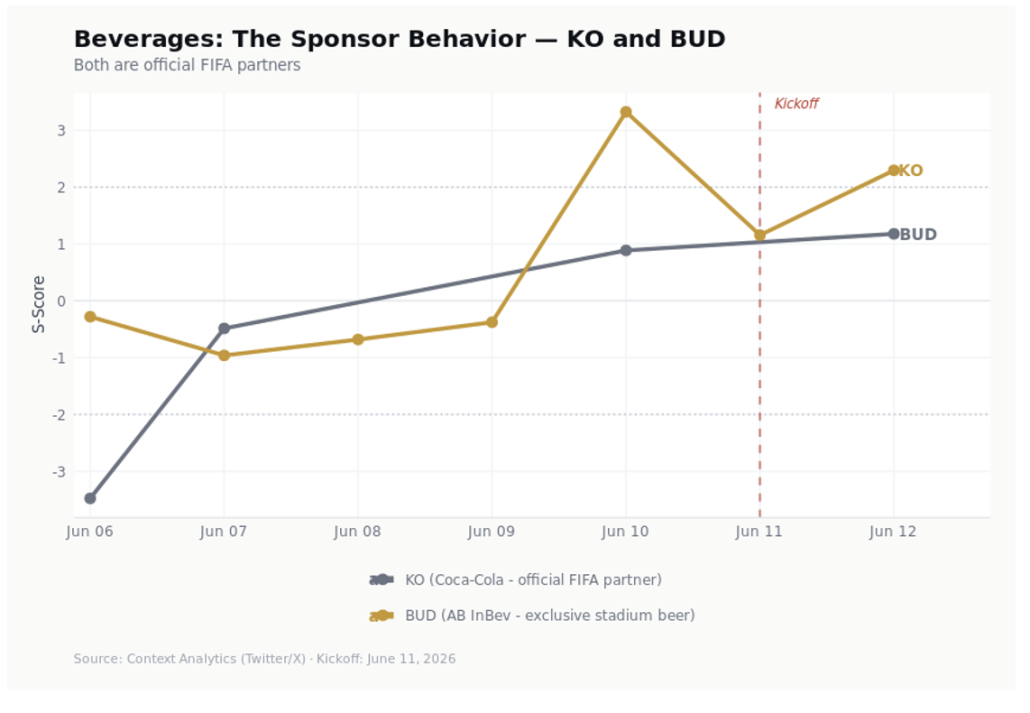
Both Coca-Cola (KO) and Anheuser-Busch InBev (BUD) entered the tournament with official FIFA partnership exposure, and both saw sentiment build ahead of kickoff. Coca-Cola showed the sharper move, with its S-Score climbing above 3 on June 10, one day before the first match, and remaining positive into the tournament.
BUD’s move was less pronounced, but it followed the same pre-kickoff direction, rising from roughly -3 to 1 over the prior four days. Together, the two sponsors reinforce the broader pattern across the dataset: sentiment was building in the days before the tournament began, even when the magnitude of the move varied by company.
KEY FINDING
The anticipation trade: sentiment peaked before kickoff
The most consistent pattern across the dataset is also the simplest: social sentiment for World Cup-adjacent stocks built in the days before kickoff, peaked on June 9 or 10, and then faded once the tournament began. That pattern appears across lodging, sports betting, beverages, transport, and media, including Fox (FOXA), which holds U.S. media rights for the FIFA World Cup.
The interpretation is straightforward. In the final days before a major global event, media coverage accelerates, advertising campaigns go live, analyst notes circulate, and fans begin discussing the brands most tied to the tournament. That conversation drives S-Score higher across exposed industries. Once the games begin, attention shifts from the companies around the event to the matches themselves, and the financial conversation starts to fade.
CONTEXT ANALYTICS – A BRIDGEWISE COMPANY
Sentiment as a real-time signal for major events
The World Cup data illustrates a broader use case: social sentiment can serve as a real-time proxy for public attention, consumer behavior, and investor mood around major events. The S-Score framework normalizes both discussion volume and tone into a comparable, time-stamped signal, making it possible to track how narratives build, peak, and fade across dozens of stocks at once.
The applications extend well beyond sports. Earnings seasons, geopolitical shocks, product launches, regulatory announcements, and cultural moments all create measurable shifts in conversation. With 33 days of the 2026 World Cup still ahead and the knockout rounds beginning June 28, this early anticipation pattern gives us a framework to monitor what comes next: which narratives sustain, which fade, and which companies see sentiment move before fundamentals or price fully respond.
To stay updated on World Cup related stock movement and how Context Analytics tracks real-time social sentiment and event-driven market narratives, visit www.contextanalytics-ai.com .