In May of this year, I had the pleasure of attending the Eagle Alpha Alternative Data Conference in London. Throughout the event, I took part in a number of conversations about data offerings and their potential use cases. One panel in particular caught my attention.
What began as a discussion about intraday alternative data quickly expanded into a broader conversation about AI adoption, specifically on the buy side. One of the speakers described how their firm was adopting agentic AI to automate work traditionally performed by entry-level research roles. This led to a wider discussion about AI adoption across the investment process and the industry more generally.
However, I could not help but feel that there was an elephant in the room, one that was not being fully addressed amid the conversation surrounding AI.
For an industry such as quantitative finance, which is largely built around identifying and preserving alpha, is there a risk that the widespread adoption of AI models will lead to a convergence of research processes, investment signals, and ultimately results? If the same models are being used across firms to support the research process, do they truly provide a sustainable edge?
In February of this year, I wrote a blog making the case that differentiated data will remain a constant, if not become even more important, in an AI-driven world. Following my experience at the Eagle Alpha conference, I wanted to explore this idea in greater depth and tailor the discussion more directly to a quantitative finance audience.
It is no secret that hedge funds operate in one of the most competitive industries in the world. The stakes are high, and firms are constantly searching for an edge or a signal that can generate excess returns that others have not yet identified.
It makes sense, then, that as generative AI has become mainstream, its use has quickly become standard practice across the industry. Research from AIMA reported that 95% of surveyed fund managers were using generative AI in their work, up from 86% in 2023. Ninety-five percent. Those figures are from September 2025, which, in AI years, already feels like an eternity ago. (AIMA)
It is fair to assume that most major funds are now deploying the technology in some capacity. These applications extend across research and information ingestion, document review, trade analytics, risk assessment, reporting, and parts of the investment decision-making process.
Another survey focused on quantitative researchers shows a similar transition from experimental use cases to core tools supporting daily work. More than half of quantitative professionals reported using AI every day, with the most common applications being code writing, research and analysis, and data analysis.(CQF)
It is therefore clear that AI is already playing a significant role throughout the quantitative research cycle, from gathering and analyzing information to model development, testing, and execution.
The widespread use of AI does not mean that every fund is operating in exactly the same way. Many firms use proprietary models, locally hosted open-sourced options, customized agents, private research environments, and their own internal data. The distribution of model use within quantitative finance almost certainly differs from the consumer chatbot market.
Still, the broader market provides a useful illustration of just how concentrated access to AI intelligence has become.According to StatCounter, ChatGPT accounted for approximately 66% of measured U.S. AI chatbot usage in June 2026. Microsoft Copilot and Google Gemini each accounted for roughly another 10% to 11%. Taken together, a small number of systems represented the overwhelming majority of measured activity. (StatCounter Global Stats)
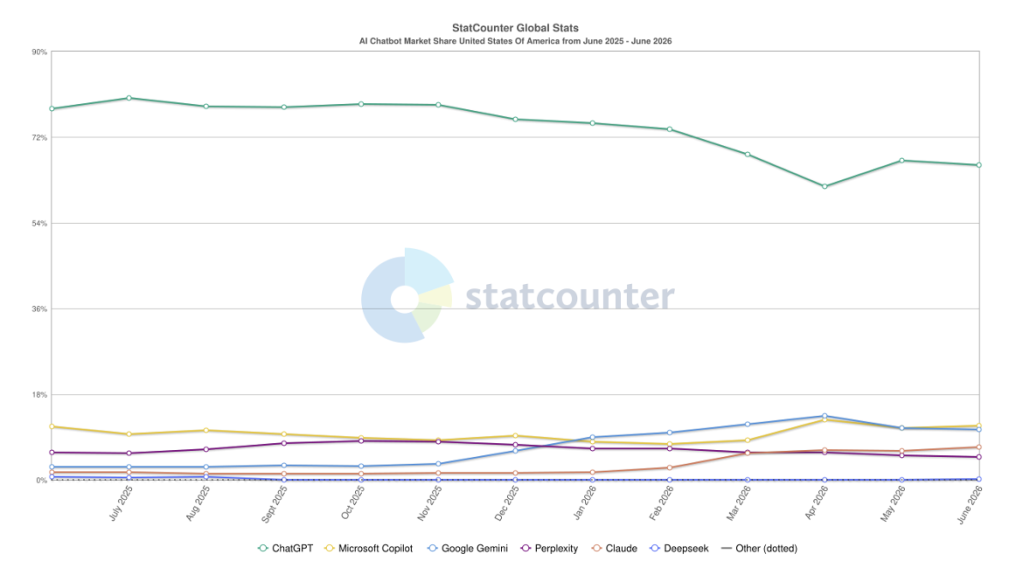
The chart is not a direct representation of which models hedge funds are using. Instead, it highlights a broader feature of the AI ecosystem: activity is concentrated around a relatively small number of foundation-model families.
Even when firms use different applications, many are built on similar underlying models, trained on overlapping public information and using comparable architectures and methods. Firms may customize these systems, but the core reasoning engine often comes from a limited group of providers.
This raises an important question. What happens to alpha when more firms build research agents around models that have learned much of the same information and tend to identify similar patterns?
The outputs do not need to be identical. They only need to be correlated enough to direct researchers toward the same companies, themes, factors, and opportunities.
AI may make each firm faster and more productive. But if competitors receive the same improvement and apply it to the same information, the relative advantage may be limited. AI can improve the research process without creating a durable investment edge.
This idea is taken further by Chen and Meng in their April 2026 paper AI-Driven Alpha Decay: Algorithmic Homogenization, Reflexive Signal Erosion, and the Paradox of Intelligent Markets. (https://ssrn.com/abstract=6349698)
The paper argues that widespread AI adoption accelerates alpha decay through signal crowding, signal erosion, and Red Queen competition.
As firms use similar models and data, they identify the same opportunities, trade on them faster, and weaken the signals through repeated use. Competitive pressure then pushes firms to invest more in AI simply to avoid falling behind.
Under the paper’s baseline assumptions, a medium-frequency signal’s half-life falls from five to seven years to about 18 months. While this research is based largely on simulations, the broader point is familiar: once a signal becomes widely known and traded, its returns decline.
AI does not create this problem. It accelerates it. A better model may provide an edge, but that edge is likely to be increasingly temporary.
This brings us back to the importance of data.
Most sophisticated firms already have access to the same fundamentals, filings, earnings calls, news, and market data. AI makes this information easier to process, but it does not make it exclusive. At the same time, the technical barriers to advanced modeling are falling. MCPs, open-source models, affordable infrastructure, and AI coding tools are making capabilities that were once limited to the largest firms more widely available.
As the technical gap narrows, data becomes a more important source of differentiation. A powerful model using commoditized information is still working within the same boundaries as its competitors. Unique data changes those boundaries.
It gives models new information to analyze, helps identify changes before they appear in traditional sources, and creates opportunities that shared datasets cannot.
The next quantitative edge will come less from having the best model and more from having information that competing models cannot see.
AI will continue to transform quantitative finance. It will make research faster, expand the number of ideas that can be tested, reduce the cost of development, and allow smaller teams to operate with capabilities that previously required much larger organizations.
However, greater analytical capacity does not automatically create more alpha. In a competitive market, it may simply allow existing opportunities to be identified and eliminated more quickly.
When every participant becomes faster, speed alone is no longer enough. When every participant has access to advanced models, access to the model itself is no longer the edge. When every model reads the same information, the outputs will inevitably begin to overlap.
The sustainable advantage will come from what is not shared. This is why we believe differentiated data will become even more important in the AI era.
At Context Analytics, we have long focused on transforming unstructured information into institutional-quality alternative datasets. As the investment industry adopts increasingly capable AI systems, our objective remains the same: to develop sources of information that allow investors to see market activity differently and identify signals that are not available through traditional data alone.
AI may increasingly become the engine powering quantitative research. But data is the fuel, and using the same fuel as everyone else is unlikely to produce a lasting edge.