Disclaimer
Context Analytics is not asserting or speculating on any health or medical claims referenced in public or social media discussions. This analysis does not evaluate scientific validity or imply any causal relationships. It focuses exclusively on how viral narratives and public perception—regardless of accuracy—can create reputational, regulatory, and market risks, and how investors can identify and monitor those risks early.
When Public Perception Becomes Market Reality
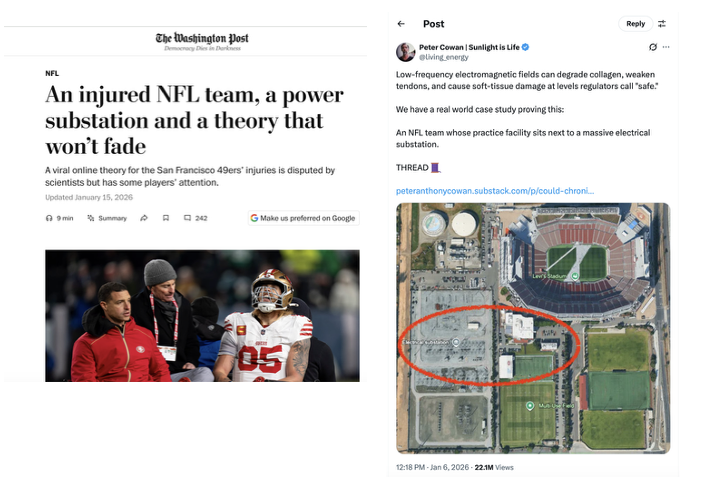
What happens when a viral conspiracy theory collides with billion-dollar infrastructure companies? We may be about to find out. A viral social media thread claiming that San Francisco 49ers players potentially suffer more injuries due to their practice field's proximity to an electrical substation has jumped from Twitter feeds to mainstream coverage, including a Washington Post article titled "An injured NFL team, a power substation and a theory that won't fade."
For investors, the truth of the claim matters less than its potential market impact. Using our Unstructured Data Terminal (UDT), we analyzed risk factors in 10-Ks from publicly traded electric utility companies to understand how this narrative could affect stock prices and operations, regardless of scientific validity.
The Reputational Risk: What Utility Companies Are Already Warning About
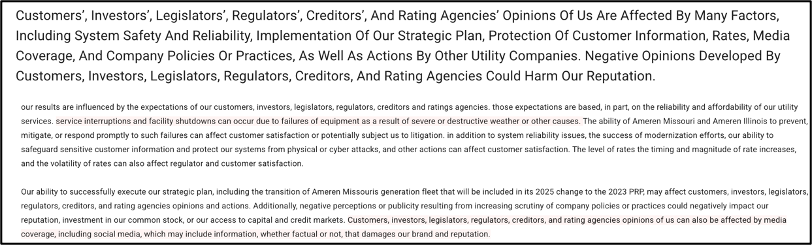
Public perception can move markets, and utility companies know it. In Ameren Corporation's (NYSE: AEE) 10-K, the company explicitly states that opinions of the company "may be affected by media coverage, including social media, which may include information, whether factual or not, that damages our brand and reputation."
This acknowledgment validates investor concern. The conspiracy theory has already achieved mainstream visibility, and with the Super Bowl broadcast reaching over 100 million viewers, this narrative could reach critical mass. If a high-profile player sustains a soft tissue injury during the game's most-watched moments, social media could amplify the electrical substation theory to a much broader audience, potentially triggering negative sentiment toward electrical infrastructure companies.
The Regulatory Threat: When Public Opinion Shapes Policy
Beyond reputation, the more significant risk lies in regulatory response. Public utilities operate in a highly regulated environment where public sentiment directly influences policy decisions.
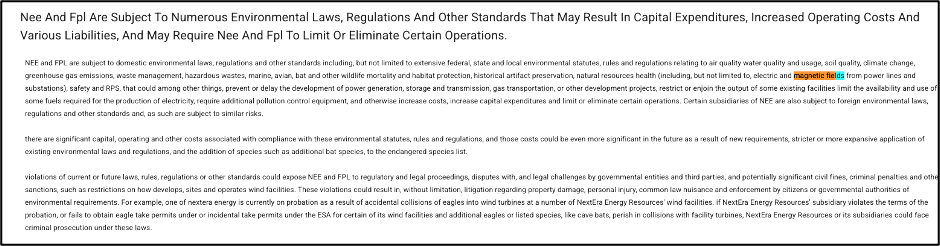
NextEra Energy (NYSE: NEE) warns in its risk factors that regulatory changes could "prevent or delay the development of power generation, storage and transmission, gas transportation, or development projects." In practice, this means that if public concern about electrical substations gains traction, new facilities could face intense opposition from local communities. Permitting delays, increased compliance costs, and project cancellations could follow.
This timing is particularly problematic. Electric utilities are racing to expand infrastructure to meet surging demand from AI data centers and the broader electrification of the economy. Companies like Microsoft, Google, and Amazon are contracting dedicated power facilities for their operations. If the "substation proximity = health risk" narrative takes hold, utilities could face significant headwinds in their expansion plans precisely when growth opportunities are strongest.
The Scientific Question: Do Companies See Credible Risk?While scientific consensus holds that electromagnetic fields from power infrastructure pose minimal health risks, utility companies themselves acknowledge uncertainty in their regulatory filings.
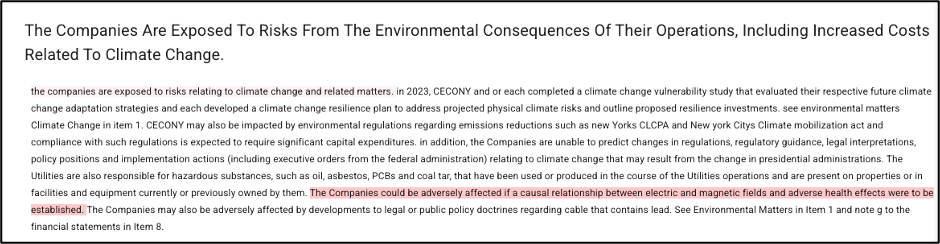
Consolidated Edison (NYSE: ED) states that "the companies could be adversely affected if a causal relationship between electric magnetic fields and adverse health effects were to be established." This careful language suggests awareness of ongoing debate and potential liability.

NSTAR (OTC: NSARO) goes further, noting that "published reports have discussed the possibility of adverse health effects from electric and magnetic fields." By referencing published research, the company acknowledges that the topic exists in legitimate scientific discourse, even if the preponderance of evidence suggests minimal risk.
These disclosures reveal that utilities are already monitoring this issue and have identified it as a material risk factor worth disclosing to investors.
What Investors Should Watch
Whether or not electromagnetic fields from substations pose genuine health risks (and again, Context Analytics is not amplifying the idea they do), the market impact of widespread belief in such risks could be substantial. Investors should monitor:
Near-term catalysts:
Companies with elevated exposure:
Actionable steps:
The Bottom Line
In financial markets, perception often matters more than reality. Even scientifically unfounded concerns can trigger regulatory responses, community opposition, and reputational damage that impact operations and stock prices. The electrical substation conspiracy theory may seem fringe today, but utility companies have already identified social media-driven reputational risks and electromagnetic field concerns in their formal risk disclosures.
Context Analytics empowers investors with real-time data to track emerging narratives like this before they move markets. By monitoring social sentiment, identifying unusual discussion patterns, and analyzing specific risk factors, investors can position themselves ahead of market-moving events rather than reacting to them.
In an era where viral theories can influence billion-dollar infrastructure decisions, early detection isn't just valuable, it's essential.
For more information, visit www.contextanalytics-ai.com.
A viral social media conspiracy linking NFL injuries to nearby electrical substations highlights how public perception—regardless of scientific validity—can create real reputational, regulatory, and market risks for electric utility companies. Utilities already disclose social media–driven reputation risk and electromagnetic field concerns in their 10-Ks, meaning widespread belief in this narrative could delay infrastructure projects, trigger regulatory scrutiny, and impact stock performance. Investors should monitor social sentiment, regulatory signals, and permitting timelines to identify risk before it shows up in the market.