Coverage of AI’s energy footprint usually picks a side. AI is either the thing that finally makes the grid smarter, or the thing that overwhelms it. Filings are a better place to look, because a company writing a risk factor or an earnings supplement isn’t trying to win that argument. It’s telling shareholders where the money and the exposure actually are.
I pulled a batch of recent filings across sectors from the MRF dataset to see what firms are putting on the record. It doesn’t reduce to a single storyline. There are at least three running at once, and they don’t fully line up, which is part of what makes them worth reading.
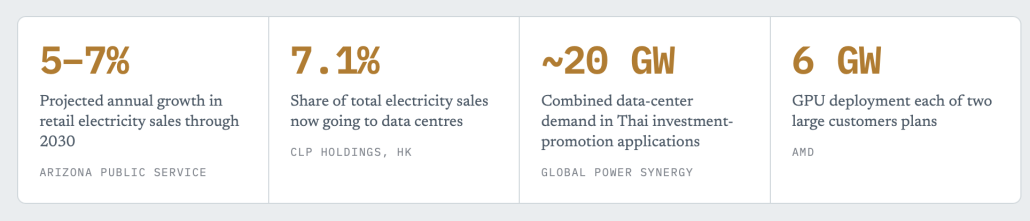
The clearest theme is that AI-driven electricity demand has moved from forecast to operating number, especially at utilities.
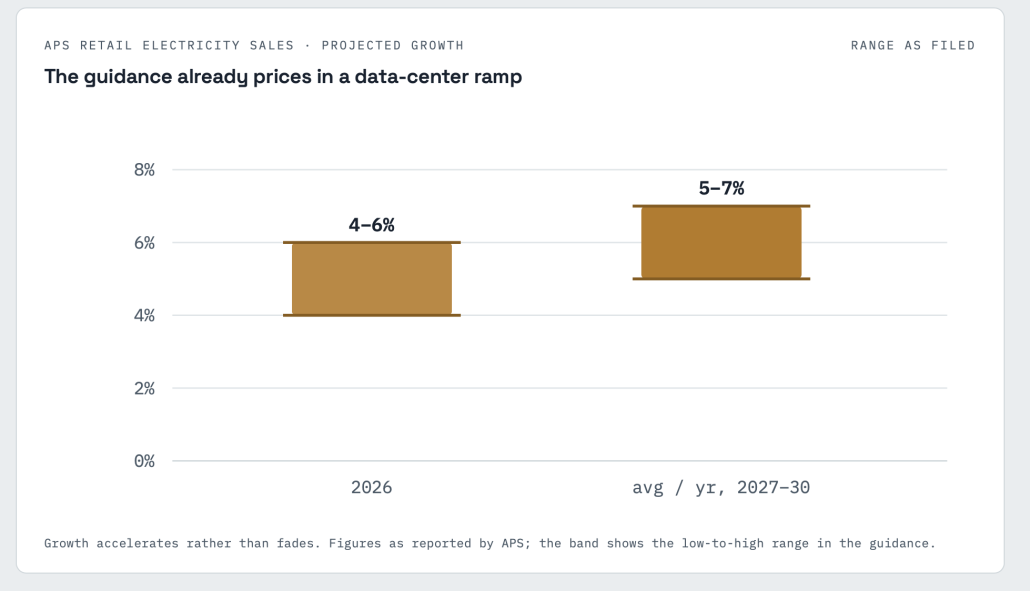
Arizona Public Service is a good example. In its second-quarter filing, the utility projected retail electricity sales growing 4 to 6 percent in 2026, and 5 to 7 percent a year on average through 2030. It named the driver: large-load customers with very high energy demands that persist virtually around-the-clock, such as data centers for AI. Around-the-clock is the part that matters. A data center doesn’t wind down at night the way a factory or an office does, and that changes how a utility plans generation.
Vistra VST described the same thing from the generation side, pointing to large-scale data centers as a contributor to what it called fast-paced load growth in its regions. The company also stood up a fund to invest in the assets that feed AI: hyperscale data centers, baseload and flexible power, transmission and distribution. When a power company builds a dedicated vehicle to finance AI infrastructure, it’s telling you where it expects the next decade of demand to come from.
This isn’t only a US story. CLP Holdings in Hong Kong reported that AI helped push electricity sales to data centres up almost 12 percent, and those customers now make up 7.1 percent of its total consumption. Thailand’s Global Power Synergy noted that data center projects seeking investment promotion in the country add up to nearly 20 gigawatts of demand. In Texas, Banpu’s US arm is consolidating gas-fired plants specifically because it sees demand accelerating from hyperscalers and AI infrastructure.
There’s also a fairness question moving through these filings: who pays for the new load. Portland General Electric POR noted that Oregon passed a law directing regulators to create a separate customer class for large data center facilities, and the utility has since proposed a distinct tariff for data center service. Thailand is heading the same way, adjusting tariffs so large users like data centers carry more of the generation and transmission cost rather than spreading it to everyone else. It’s a reasonable thing for regulators to work out, and the filings suggest they’re working it out now rather than later.02 — THE CONSTRAINT
Electricity gets most of the attention, but several filings flag water and heat as the tighter constraints.
AMD AMD put it about as plainly as a 10-Q allows: data centers depend on access to clean water and reliable energy. It went on to say that if its customers can’t secure enough power or water, or if they hit shortages, they may build less capacity and buy fewer chips. That’s worth noticing, because AMD sells the GPUs. When a chipmaker lists water availability as a risk to its own revenue, the constraint has climbed a long way up the supply chain.
When a chipmaker lists water availability as a risk to its own revenue, the constraint has climbed a long way up the supply chain.
The cooling side is turning into a genuine business, which is where a lot of the opportunity is. Modine MOD reorganized its climate solutions unit and carved out a standalone data centers segment, and it’s investing heavily to expand cooling capacity: chillers, rear-door heat exchangers, coolant distribution units, immersion systems. Demand grew fast enough that ramping production actually pressured margins for a quarter. Schneider Electric SU reported the same pull, with the data center market leading its energy management growth and particular strength in cooling and backup power. When cooling equipment becomes a growth story, you’re watching a physical bottleneck get priced, and companies get built to solve it.03 — THE OTHER SIDE OF THE LEDGER
Plenty of companies describe AI as something they’re using to cut consumption, not just something that raises it. The same technology shows up on both sides of the same filings.
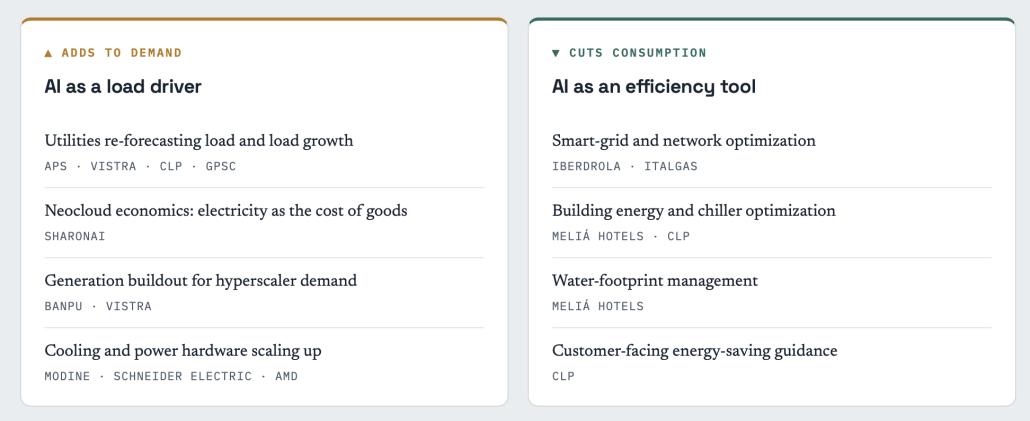
Meliá Hotels MEL is a detailed case. It has run a project since 2019 that uses AI to optimize its chiller units, and a second one applying AI to manage its water footprint across hotels. It also adopted a formal policy on the responsible and sustainable use of AI. Iberdrola IBE describes AI projects aimed at making the electricity system more resilient, tied to smart grids and renewables. Italgas expects AI in its network operations to deliver roughly 280 million euros in efficiencies by 2032. CLP, the same utility booking higher data center load, is also using AI to give customers energy-saving tips and to run a more efficient cooling system at a Hong Kong hotel.
It’s worth holding these two threads side by side. The same technology shows up as a load driver in one part of a filing and an efficiency tool in another, sometimes at the same company. Both can be true. Whether the efficiency gains offset the demand growth across a whole system is the thing no single filing can settle, and most of them don’t pretend to.04 — THE REACH FOR BASELOAD
Read enough of these and one word recurs around AI power demand: nuclear. The reasoning is simple. AI wants large amounts of steady, low-carbon baseload, and that fits nuclear better than it fits intermittent renewables without a lot of storage.
Mirion Technologies MIR pointed straight at the power demands of data centers, cloud, and AI as something nuclear can serve, including small modular reactors. First Hydrogen described an SMR research project motivated by the fact that AI data centres can use several times the energy of a normal one. Even Hyundai Steel is positioning for it, developing heavy plates for next-generation nuclear plants and reactor components as it chases AI infrastructure demand. When a steelmaker retools for reactor vessels partly on the strength of AI power needs, the supply chain has clearly bought into the thesis.
First Hydrogen also repeated a claim worth handling with care: that a single generative AI query is roughly like leaving a light on for twenty minutes. I’d take that specific number with a grain of salt, since figures like it get passed around without much agreement on how they’re measured. But its appearance in a securities filing shows how far the energy-per-query framing has traveled, from opinion pieces into the documents companies use to explain themselves to investors.05 — THE CANDID ONES
The most candid language comes from firms whose whole business is AI compute, because for them energy isn’t a footnote, it’s the cost structure.
SharonAI, an Australian AI cloud operator, laid it out in its registration statement more plainly than the big platforms usually do. It said its work is energy-intensive enough that it may have to locate where renewable power is available. It flagged that regulators could limit electricity suppliers from serving AI and data center operators. And it stated that the business only works if the cost of electricity and hardware stays below what it charges for the service. That last point cuts through a lot of abstraction. An AI cloud is, in financial terms, a way of turning electricity into computing, and the margin sits in that spread. The company also disclosed a joint venture to build a data center next to a natural-gas plant in West Texas, which is an honest look at what securing power can involve in practice.06 — THE TAKEAWAY
Taken together, these filings describe a system reorganizing itself around a large and steady new customer. Each link in the chain is repricing at once.
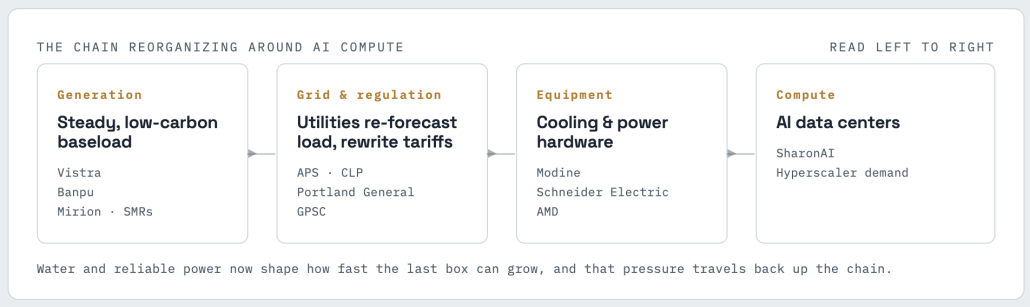
For investors, the useful read isn’t that AI is good or bad for sustainability. It’s that AI is redrawing the map of where power, water, cooling, and generation capacity get valued, and a lot of that is showing up first in the filings rather than the headlines. The optimistic and cautious versions of the story both have support here. AI is measurably raising electricity and water demand, and it’s being put to work making grids, buildings, and cooling systems more efficient. The net effect is still being written, and it’ll show up in the same place these early signals did: in the operating numbers.