At Context Analytics, we turn the conversation on Twitter into structured, tradable signals. Our S-Factor Feed scores that conversation for thousands of securities every minute of every day, giving traders and investors the building blocks for sentiment-enhanced strategies.
In this post, we revisit the Monthly Long-Only Strategy, built on the Raw-S factor and applied to S&P 500 constituents. We introduce the monthly sentiment metric behind it, walk through how the portfolio is selected and rebalanced, and look at what the signal rewards and how it shapes the holdings.
Monthly Weighted Sentiment aggregates a month of daily Twitter sentiment scores into a single value per stock, with the most weight on the final days of the month, closer to the rebalance date. It is built in two steps.

Here Nm is the number of days in month m. The last day of the month carries a weight of 1.0, a day one week earlier about 0.48, two weeks earlier about 0.23, and the first day of a 30-day month about 0.05. The score therefore reflects where sentiment stands as the month closes, while still counting how persistent it was.
A stock is only scored if the conversation around it is active. We require an average of at least one S-Volume per day over the month, which keeps thinly discussed names, whose scores rest on a handful of Tweets, out of the ranking.
The portfolio is rebuilt once a month from the S&P 500 stocks with the highest Monthly Weighted Sentiment, weighted by market capitalization.
The four-day gap between the end of the scoring month and the trade is deliberate. Every input to a rebalance (sentiment, market capitalization and index membership) is known days before the order is placed, so the backtest does not rely on information an investor would not yet have had.
Monthly Weighted Sentiment rewards stocks that are both widely discussed and discussed favorably, and it leans toward how that conversation looks at month-end.
Since 2018, the strategy has delivered a 249.7% cumulative return, ahead of SPY's 226.2%.
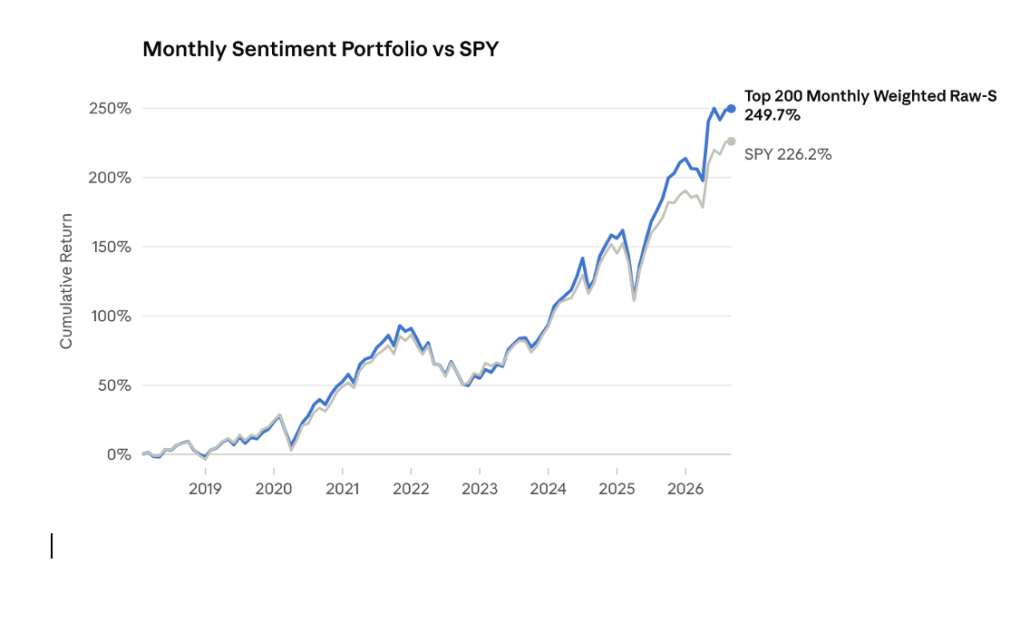
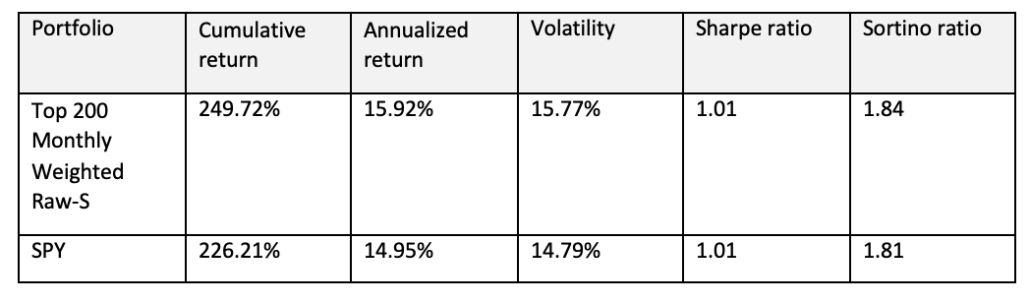
Monthly holding periods are from February 6, 2018 to September 4, 2026.
The same features explain both where the strategy earned its edge and where it gave ground. Large, heavily discussed stocks that the conversation favored entered the portfolio at meaningful weights, and their strongest months drove much of the outperformance. The tilt cuts both ways: popular names can also fall sharply when the narrative turns.
The result is a portfolio that has kept pace with the S&P 500 in weaker markets and pulled ahead when sentiment-driven leaders rallied, at the cost of somewhat higher volatility than the index.
Sentiment moves prices, and Twitter remains one of the fastest real-time public forums into what investors think. Aggregating that conversation with Context Analytics' S-Factor Feed turns a noisy daily stream of messages into an actionable signal that captures both how strongly and how recently the crowd has formed a view.
This Monthly Long-Only Strategy shows how that signal can be put to work in a simple, transparent, index-like portfolio. To learn more about the S-Factor Feed and our other data-driven solutions, visit contextanalytics-ai.com.