 company
BACKGROUND
Moderna (NASDAQ: MRNA) delivered one of the sharpest single-name reactions of the year on Wednesday, August 19th, after Moderna and Merck announced their Phase 3 INTerpath-001 trial had positive results. It is the first randomized trial to validate a personalized neoantigen cancer vaccine, a milestone with implications well beyond melanoma given the nine ongoing trials in Moderna's broader INTerpath oncology program.
The market reaction was immediate and extreme: Moderna shares moved from a premarket gain of roughly 90% to more than 145% by the morning session, ultimately closing up nearly 177% on the day. This is one of the largest single-day moves for a company of Moderna's size in recent history. For a signal built to detect abnormal shifts in sentiment, this is close to a clean-room test case. The question a case study like this is really asking is not "did sentiment move", since sentiment always moves on news like this, but how quickly did the shift become statistically distinguishable from noise.
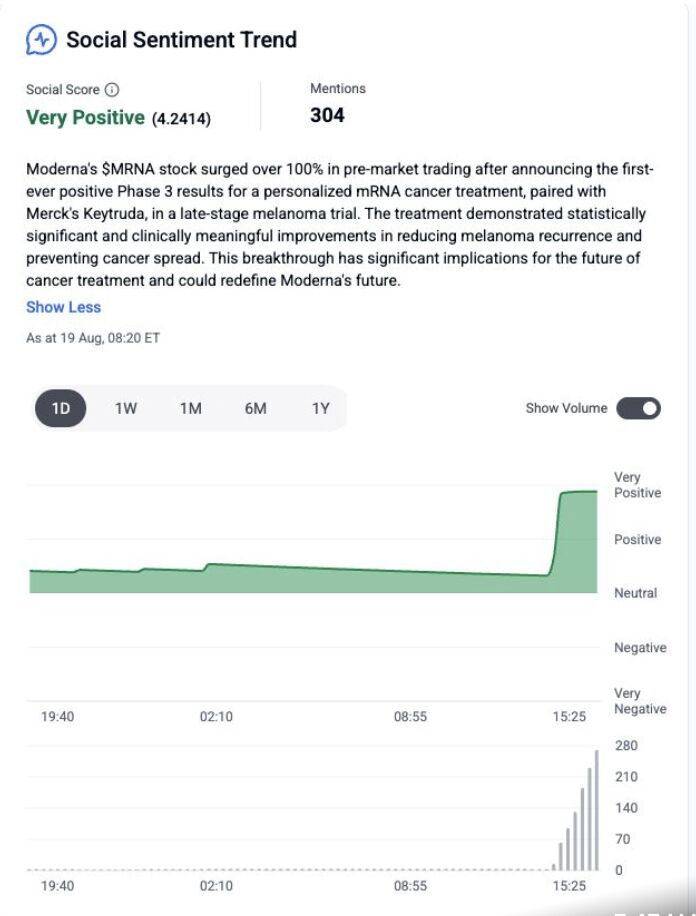
$MRNA, captured intraday at 8:20 AM ET — Social Score already at 4.2414 ("Very Positive") on 304 mentions, well ahead of the broader market's reaction.
WHAT CONTEXT ANALYTICS MEASURED
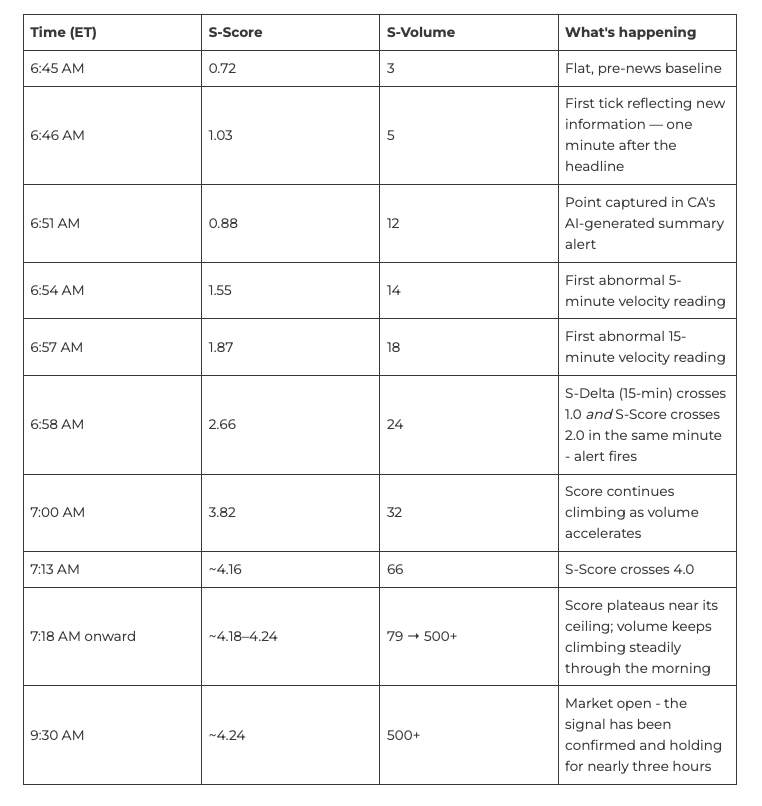
Context Analytics' S-Factor feed updates every minute, and the minute-by-minute record from that morning gives an unusually granular look at how a sentiment shift actually builds, first as noise, then as a directional move, then as a statistically confirmed signal, and finally as a plateaued, high-conviction state that held for hours.
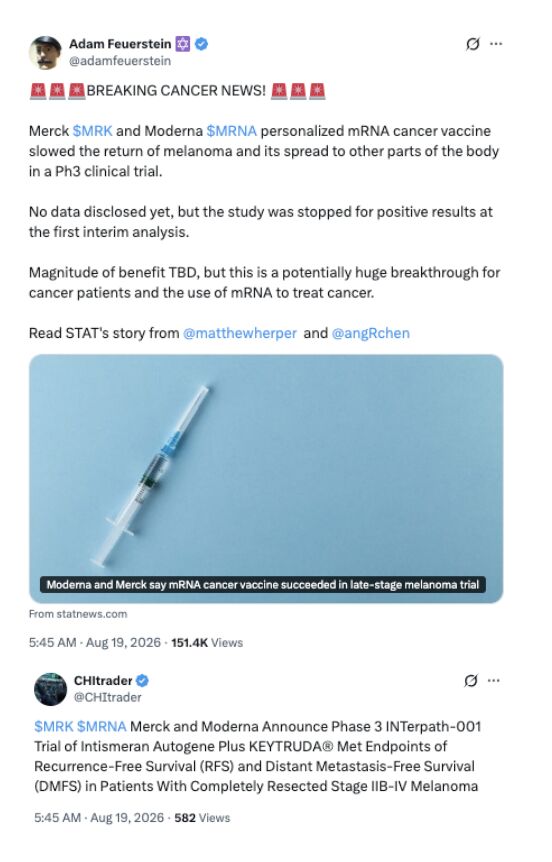
The market-moving headline itself, via biotech reporter Adam Feuerstein — timestamped 5:45 AM Central, which is 6:45 AM ET: the same minute S-Factor's baseline reading was still flat.
WHAT OUR CALCULATIONS MEAN
The 6:58 AM mark is the pivot point. Two independent thresholds, abnormal velocity (S-Delta) and abnormal magnitude (S-Score) breached at once, backed by a nearly eightfold jump in message volume from the pre-news baseline.
That is not "sentiment is positive." That is "sentiment is moving faster and higher than is typical for this security, and the move is corroborated by a surge in message volume at the same instant" - a materially different, and more actionable, statement.
After 7:18 AM the S-Score doesn't keep climbing indefinitely; it plateaus near its ceiling and holds there, while S-Volume keeps increasing for hours.
WHY THIS MATTERS
S-Score is a Z-score: it measures how a security's current sentiment compares to its own trailing 20-day baseline, so a reading above 2.0 means the conversation is running more than two standard deviations more positive than what's typical for that name, a statistically meaningful shift, not just "more positive tweets."
S-Delta measures the rate of change in that score over a trailing window (5- or 15-minute), which is what lets the feed distinguish a security whose sentiment is actively shifting from one that is simply sitting at an elevated level.
By the time Moderna's move was a headline most desks would see, S-Delta had already flagged the abnormal velocity, S-Score had already confirmed the sentiment magnitude, and S-Volume had already corroborated both with a real surge in conversation.
All three had been holding, not fading, for nearly three hours before the opening bell. That's the case for treating sentiment as a measurable precursor to price rather than a lagging description of it: delivered via API, in the same window an institutional desk needs to act, not after the fact.
THE TAKEAWAY
Not every velocity breach turns into a 150%+ single-day move, and no single signal sentiment included should be read in isolation. But the value of a rate-of-change metric like S-Delta is precisely that it doesn't wait for sentiment to look obviously positive before flagging that something is changing. With the paired factors, Context Analytics, A BridgeWise Company, gives users an early, statistically grounded read on whether a name is undergoing a genuine narrative shift, before that shift becomes consensus.
To learn more about how S-Factor's metrics or SentimentWise widgets can be integrated into your workflow, visit contextanalytics-ai.com or reach out to the CA team directly.