 company
In this series we've reported that about 57% of US annual reports now mention artificial intelligence. That number invites an obvious follow-up question: what happens to it when the hype cools?
AI isn't the first technology to sweep through 10-K filings. Blockchain arrived in 2017 and 2018. The metaverse and NFTs followed in 2022. So we went back to the filings and asked what became of those words once the excitement faded. We used the Elastic Filings MCP to search twelve years of US 10-Ks, from 2014 to 2026, and then followed individual companies from one year to the next.
The short answer is that hype words rarely disappear from filings, but the companies using them change almost completely. Large companies quietly edit the words out. Small companies and shell companies keep them, and some rename themselves after the next buzzword. A new set of filers often arrives and keeps the overall rate flat. If you only watch the headline percentage, you miss most of that.
Every hype term got in, but only AI took off
AI went from 16% of 10-Ks in 2023 to 56% in 2026, a rise no earlier buzzword came close to. Blockchain climbed over twelve years, with a few small dips, to about 8%. The metaverse peaked at 1.2% in 2023 and has fallen by about half since. NFTs have stayed between 1.0% and 1.4% since 2022.
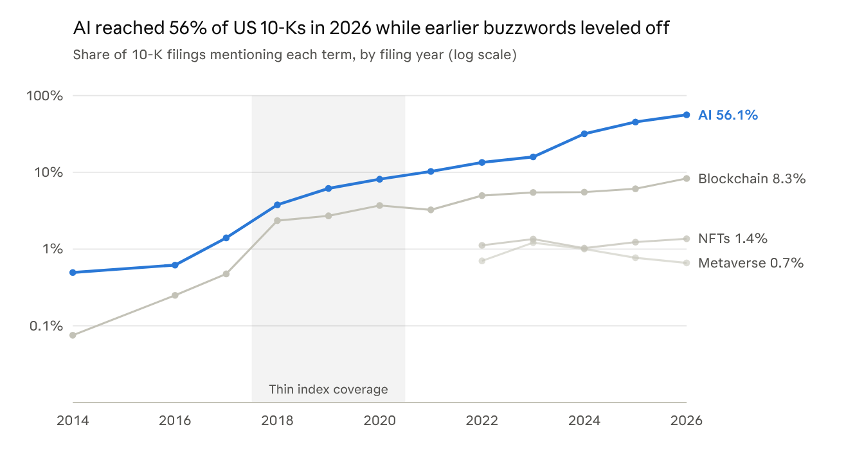
Elastic Filings MCP, US 10-K indices, queried November 2026 · 2015 not sampled · metaverse and NFTs shown from 2022
AI's jump begins with the 2024 filings, which cover 2023, the first full year after ChatGPT launched. Neither the metaverse nor NFTs ever dropped back to zero, which is the question the next sections take up.
Large companies edit it out
Of the companies that mentioned the metaverse or NFTs in 2023 and still file today, nearly 6 in 10 have removed the word. We took every company that used each term in its 2023 10-K and checked its 2026 filing. The results for the two terms are close to identical.
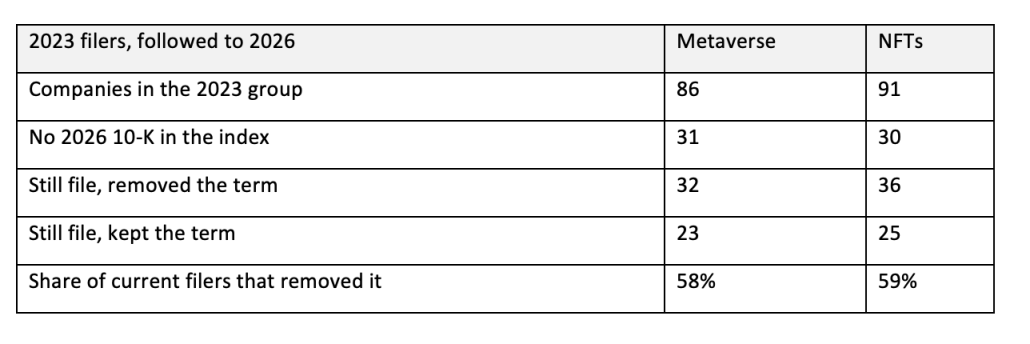
The names on the "removed" side are mostly large companies. NVIDIA, Accenture, Booking Holdings, Booz Allen Hamilton, Ralph Lauren, Seagate and MercadoLibre all dropped the metaverse. Mastercard, Northern Trust, GameStop, Mattel and Getty Images all dropped NFTs.
The companies that kept the words fall into two groups. Some have a real business connected to the term: Meta and Roblox still discuss the metaverse, and Coinbase, DraftKings and Funko still discuss NFTs. The rest are mostly micro-caps.
About a third of each 2023 group has no 2026 10-K in the index. Some were acquired or taken private, such as Maxar and Thoughtworks, and several were SPACs. Sixteen of them did file a 10-K in 2025, so some may be late filers or have fiscal years that end later in 2026.
Small companies move on to the next word
The same company identifier follows a filer through every name change, and some of those changes say a lot. Several companies in the 2023 groups have since renamed themselves after a newer trend:
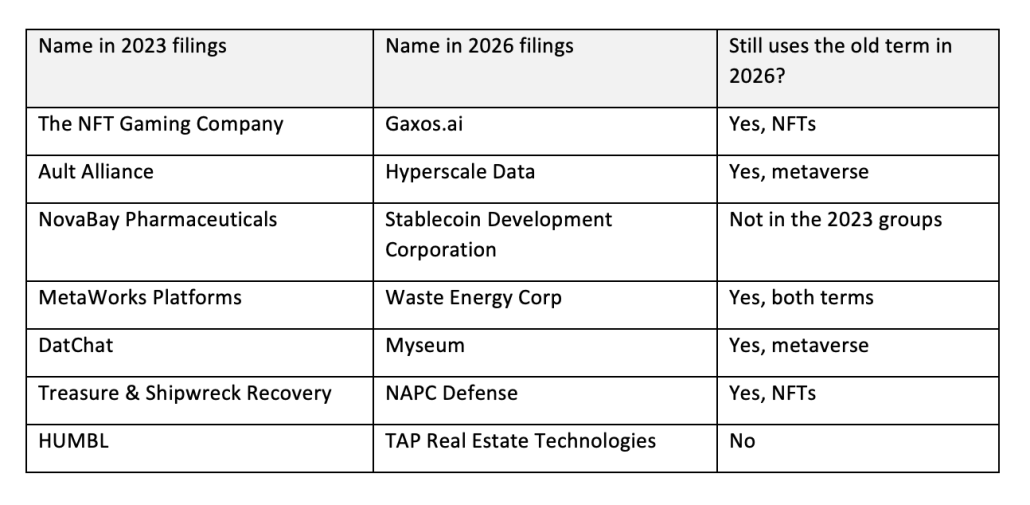
The most direct case is outside the table because it has no 2026 10-K yet. AB International Group discussed NFTs in its 2023 filing, then filed a 2025 amendment under the name AI Era Corp.
One pattern stands out. Several companies took a new name and kept the old language. Gaxos.ai still discusses NFTs, and Waste Energy Corp still discusses both the metaverse and NFTs. The new name follows the current trend, while the filing text still carries the last one.
This is the long tail behind the slow fade. Large companies rewrite their risk factors when a term stops being relevant. Small companies keep the old wording and add the new trend on top.
Same rate, different companies
NFT mentions stayed between 1.0% and 1.4% of 10-Ks from 2023 to 2026, yet only 25 of the 89 companies mentioning NFTs in 2026 were also in the 2023 group. Many of the companies behind the number have been replaced.
The 64 new names fall into three groups:
- Crypto ETFs and trusts. About 27 are funds launched in 2024 and 2025 that hold Solana, Ethereum, XRP, Dogecoin and other tokens. Their standard risk-factor language mentions NFTs as part of the wider digital-asset market.
- Crypto-treasury and DeFi companies. Judging by their names, about 8 are small companies that now hold tokens on their balance sheets, including DeFi Development, SUI Group, FG Nexus and TAO Synergies.
- Everyone else. This includes Reddit, Take-Two, Robinhood and Tradeweb, plus several regional banks.
The banks show how these words spread. Glacier Bancorp and First Northwest Bancorp use the same sentence, listing NFTs among the speculative areas that clients might move money into. SLM and Citizens Community Bancorp use a close variant that frames NFTs as competition for deposits. The near-identical wording points to shared templates, so a term can spread through a sector from one draft to the next.
In 2023, NFT mentions came mainly from gaming, collectibles and metaverse companies, with about 10 crypto trusts. In 2026 the largest group is crypto funds, at 34 of 89 companies, followed by template risk language at banks. The headline rate barely changed, but what it measures did.
Blockchain's second wave
Blockchain is the only older hype term still rising, and the 2026 jump comes from new kinds of filers, not from older mentions. The share of 10-Ks mentioning blockchain rose from 6.1% to 8.3% in a single year, 567 filings in 2026. We split those filings into two groups:

The older style of blockchain mention is fading slowly, from 4.8% of 10-Ks in 2025 to 4.3% in 2026. The new wave tripled. Filings that pair blockchain with stablecoins went from 79 to 239, the year stablecoin legislation passed. Blockchain filers with ETF, Trust or Fund in their names, a rough stand-in for crypto funds, went from 36 to 66.
The pivots are back as well. NovaBay Pharmaceuticals is now Stablecoin Development Corporation. Several other small companies outside finance have moved into holding crypto on their balance sheets. It is the same move companies made in 2017, when some added "blockchain" to their names.
What this means for AI's 57%
The AI figure will probably stay high even after the hype fades, so a high figure alone tells you little. The useful signal is which companies are adding AI language, removing it, or rewriting it.
The earlier hype cycles suggest three questions worth asking about AI as the cycle continues:
- Are large companies trimming AI language? If NVIDIA and Accenture trimming the metaverse was the early sign that hype was fading, large companies cutting generic AI boilerplate would be the equivalent sign for AI.
- Who is adding it for the first time? If newly listed companies, renamed shells and SPACs make up most of the new AI mentions, the rate is rising for reasons that say little about how established businesses use AI.
- Is the wording shared? Identical risk-factor sentences across many filers point to templates spreading through a sector, not separate decisions about AI.
The difference is scale. Blockchain reached about 8% of 10-Ks in 2026, and the metaverse peaked at about 1% in 2023. AI covers more than half of them. Even so, following individual companies over time, rather than watching the overall share, is the only way to tell real adoption apart from boilerplate.
Track AI language across your own coverage
We followed two hype terms through 153 companies. The same company-level tracking works for AI language across a sector, an index or a watchlist. It shows which holdings added AI language, which removed it, and which are using sentences copied from a shared template. If you want that view of your own coverage, get in touch and we'll run it.