 company
Podcast audio is abundant. Knowing where the useful financial information comes from is not. Introducing the Context Analytics Podcast Source Rating.
There are now more than 4.5 million podcasts worldwide and hundreds of millions of listeners: a large, growing stream of conversation about companies, executives, industries, and market themes.
The problem is no longer access. It is Attention
With so much audio being produced, the question becomes which conversations are worth attention.
Our Podcast Sentiment Analysis Feed already turns podcast audio into structured financial data: transcription, company mapping, sentiment, relevance scoring, and searchable summaries. The next problem was which sources consistently produce useful financial information. That led us to the Context Analytics Podcast Source Rating.
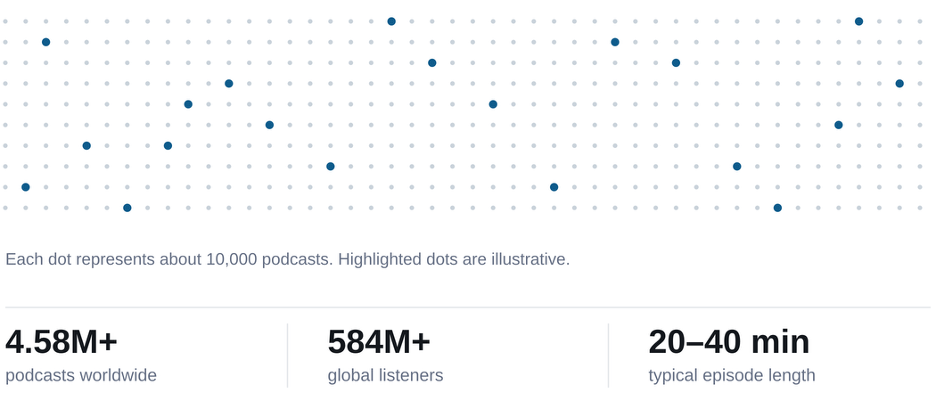
Figure 1. The attention problem: podcast audio is effectively unlimited; the constraint is deciding where to listen. Source: PodcastStatistics.com.
Popularity is not the same as financial relevance
Most podcast discovery is built on popularity: audience size, downloads, engagement. Useful signals, but they do not tell an investor which sources consistently produce substantive financial information.
A globally popular show might discuss public companies only occasionally, while a smaller specialized one covers earnings, M&A, and central-bank decisions in depth every week. For research, the second is more valuable, and the Source Rating quantifies that.
That gap shows in our own output. Among the highest-rated sources is Eurodollar University, an independent monetary-policy show with no mass-market audience. Nearly every episode is about what investors price, so it rates above far larger business podcasts.
Measuring the value of a financial podcast
The Source Rating combines several signals into a single 0–100 rating built for financial research. Rather than leaning on audience size alone, it scores a source across five dimensions.
Financial-market relevance
The heaviest weight is alignment with what financial professionals care about: earnings, macro, central banks, M&A, regulation, and market-relevant technology. The goal is to separate market-focused shows from those mentioning finance in passing.
Recent activity
A source must also be active. The rating considers whether a show still publishes, separating ongoing market discussion from an archive that was relevant historically.
Company-level relevance
We also weigh the substance of company discussion. Because the feed already scores relevance on every mention, the rating reflects whether companies are covered in depth or named in passing.
Breadth of company coverage
The rating also considers how broadly a show covers public companies. Shows discussing many names produce a richer stream of security-level information.
Audience reach
External audience data adds a measure of reach, but deliberately counts for only one part. A niche, highly relevant show can rate strongly without a mass-market audience.
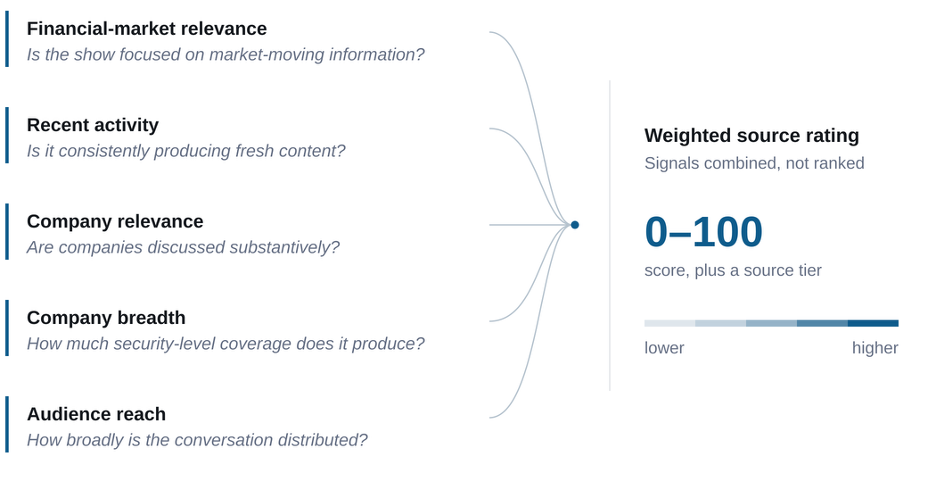
Figure 2. Five signals weighted into one rating, so a source is judged on research utility rather than popularity.
A consistent standard, not a leaderboard
A rating reflects a show’s own characteristics, not its position relative to other podcasts. As the universe grows, the definition of a high-quality source stays stable rather than shifting as new shows enter, which makes it a better filtering variable in production.
What a high-rated source looks like
Because the rating is absolute rather than relative, the top of the distribution shows what the framework rewards. Below are examples of high-rated sources; several would not appear on any general podcast chart.
| Alpha Casts – AI Market Intelligence | Saxo Market Call |
| Barron's Streetwise | Stock Movers |
| Eurodollar University | Tech Brew Ride Home |
| Exchanges | The Commuter Top Headlines Podcast Network |
| Fintech Insider Podcast by 11:FS | The Information's TITV |
| Marketplace All-in-One | The Rundown |
| Marketplace Tech |
Table 1. Examples of high-rated sources, listed alphabetically rather than by rank. Ratings update as new episodes publish.
Some patterns are unsurprising. Institutional research shows (Exchanges from Goldman Sachs, Saxo Market Call, Barron's Streetwise) cover markets nearly every episode and name specific companies. Business and technology dailies such as The Information's TITV and Marketplace Tech rate well because they publish constantly across a wide set of companies.
Filtering the financial conversation
The Source Rating is most useful combined with the company-level relevance score already available in the Podcast Sentiment Analysis Feed.
Suppose a researcher is monitoring NVIDIA. A search returns every episode mentioning it, but not every mention carries the same information. Instead, isolate high-relevance NVIDIA discussion on higher-rated sources. Two filters:
Source Rating: Is this generally a strong source of financial information?
Company relevance: Is NVIDIA an important part of this conversation?
From there users reach the transcript, company summary, sentiment metrics, and timestamps around the discussion.
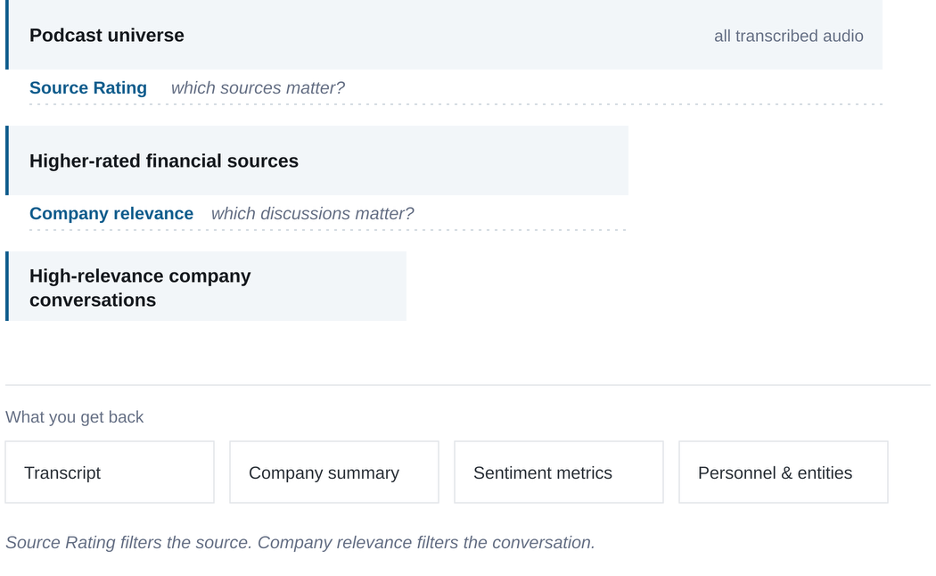
Figure 3. Two filters in sequence turn a large universe of audio into a short list worth reading.
More than a podcast ranking
The Source Rating is not a subjective list of the best podcasts. It is a data feature for filtering a large universe of audio: prioritizing stronger sources, filtering company alerts, building custom universes, and tracking narratives.
It also adds a dimension to alternative-data research: source quality can itself be a feature, since not every observation needs equal weight.
Our feed made financial audio measurable; the Source Rating makes it filterable. The goal is not to have investors listen to more podcasts, but to identify which conversations are worth listening to.
Integrating the Source Rating into your models
The Source Rating ships as a field in the Podcast Sentiment Analysis Feed, alongside company relevance scores, sentiment, transcripts, and summaries. Use it as a filter, a weight on sentiment, or a feature in its own right.
To see how source quality performs in your own research, contact us at contactus@contextanalytics-ai.com or request a sample at www.contextanalytics-ai.com. We can walk through the methodology, coverage, and how the rating fits your pipeline.